
The car pulls or drifts
You have to hold the wheel against a steady tug to one side on a flat, straight road. That's an alignment angle out of range, not just the road crowning.
Falamos PortuguêsHablamos Español
Mon–Fri: 8am–5pmRepair & Service
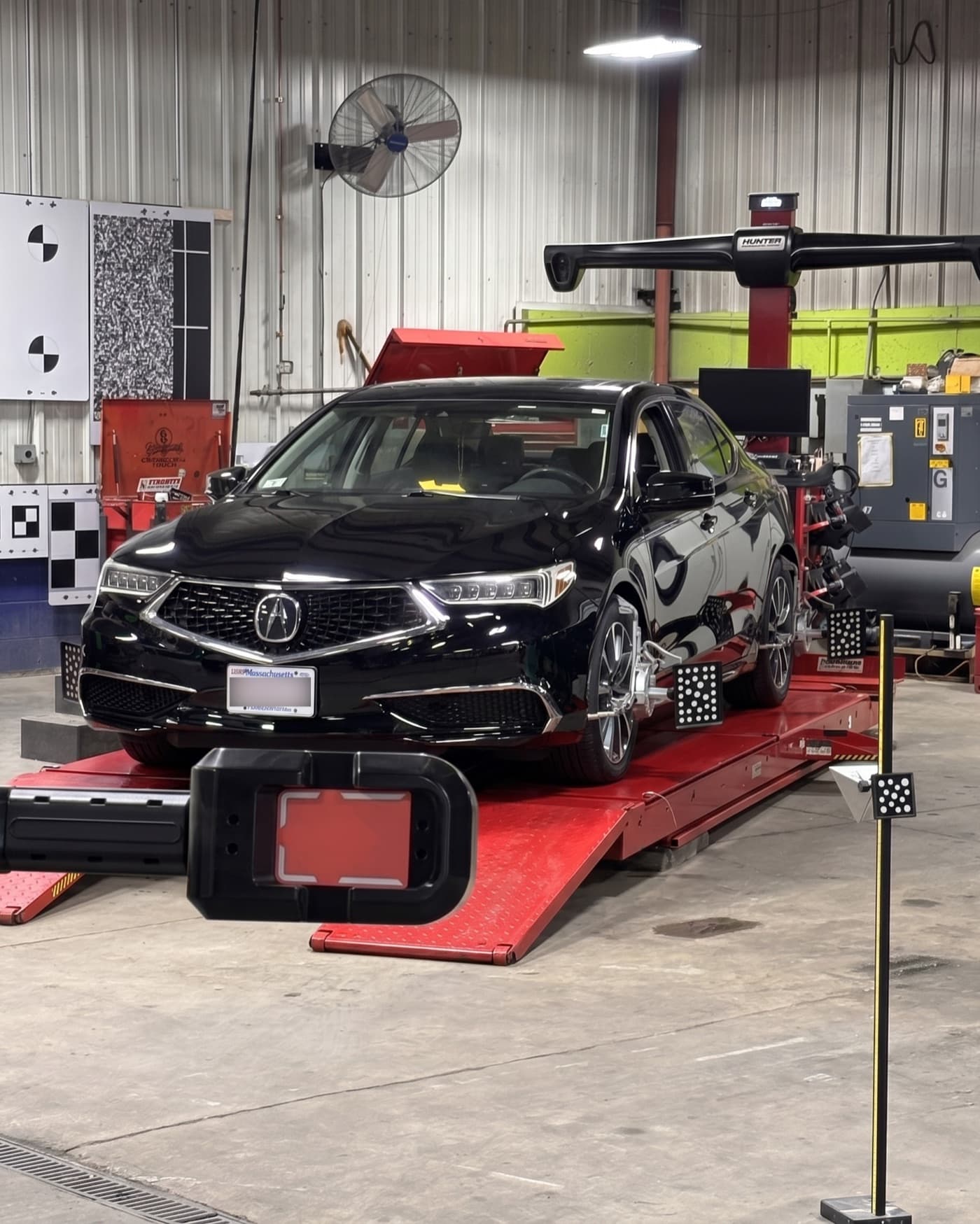
Camber, caster, and toe. The three angles that decide whether your car tracks straight, wears its tires evenly, and steers where you point it. We measure all four wheels on the computerized rack and show you the numbers before and after.
The work, in depth
Alignment is about the angles your wheels sit at relative to the road and to each other: camber (the inward or outward tilt seen from the front), caster (the steering-axis tilt seen from the side), and toe (whether the wheels point straight ahead or slightly in or out). When those angles drift out of the factory range, the car fights you: it pulls or drifts, the steering wheel sits off-center, and the tires scrub as they roll instead of rolling clean.
Left alone, a bad alignment costs you on two fronts. It chews through tire tread on one edge, so a set that should last for years wears out early and unevenly, and it makes the car work harder to go straight, which drags on fuel economy and handling. We put the car on the computerized 4-wheel rack, read where every angle actually is, adjust what the vehicle lets us adjust back to spec, and road-test it so you feel the difference on the way out.
Quick facts
What’s included
Know the signs
You have to hold the wheel against a steady tug to one side on a flat, straight road. That's an alignment angle out of range, not just the road crowning.
You're driving straight but the wheel sits cocked to one side. The toe is off, and it won't correct itself.
One edge of a tire is worn down while the rest looks fine, or the tread feels sharp and feathered when you run a hand across it. That's the tire scrubbing sideways as it rolls.
A hard hit can knock the angles out in an instant. If the car felt fine before and pulls after, that's usually why.
A fresh set is the worst time to run a bad alignment: you'll wear expensive new tread unevenly. Check it now, not after the damage is done.
Replacing tie rods, control arms, or struts changes the geometry. The alignment has to be reset to spec afterward, every time.
How it works
We put the car on the computerized 4-wheel rack and read where camber, caster, and toe actually sit against the factory spec for your vehicle. Before we touch an adjustment, we check the tie rods, ball joints, and bushings, because you can't hold an alignment on worn parts.
We bring every angle the vehicle lets us adjust back into the factory range. If a worn part needs replacing first, we quote that in writing before we do it, so nothing happens without your say-so.
We drive the car to confirm it tracks straight and the steering wheel sits level, then hand you the before-and-after readings so you can see exactly what changed.
Straight pricing
Alignment pricing depends on your vehicle and what the wheels need. We give you a written, fixed-price quote before any work, and if worn suspension parts have to be replaced first, you'll see that on the quote before we start, not after.
What affects the price
Common questions
Still not sure? Give us a call at (508) 730-2282 and we’ll talk it through.
There's no fixed mileage. Get it checked when you notice a pull, an off-center wheel, or uneven tire wear, after you hit a bad pothole or curb, and any time you put on new tires or have suspension or steering work done. A yearly check is a reasonable habit if you drive rough roads.
It's the best time to do it. New tires are a real investment, and running them on a bad alignment wears the tread unevenly from day one. Checking the alignment when the tires go on protects that set for its full life.
If the pull is caused by the alignment angles being out of spec, yes, that's exactly what it corrects. A pull can also come from uneven tire pressure, a worn tire, or a brake issue, so we confirm the actual cause on the rack before we tell you an alignment is the fix.
A 2-wheel (front) alignment adjusts the front wheels only. A 4-wheel alignment measures and, where adjustable, corrects all four, and it accounts for how the rear wheels are tracking relative to the front. We measure all four on the rack either way so you know what your vehicle actually needs.
Related services
Pads, rotors, ABS, struts, shocks, and steering, we show you the worn part before we replace it.
Repair, replacement, performance checks, cooling, fuel, and ignition, diagnosed before we quote.
Cabin heat and A/C diagnostics, compressor and evaporator service, comfort, sorted.
Ready when you are
We start with a diagnostic to pinpoint the problem, then schedule any repairs once you've approved a written quote.